

Why In-Process Cleaning Matters in Precision Manufacturing
What is in-process cleaning?
In-process cleaning removes chips, swarf, and machining residue from a part immediately after it's cut — at or near the machine itself — rather than waiting until the end of the production line. Instead of allowing contaminants to travel through downstream operations like assembly, inspection, and finishing, in-process systems like Sugino's JCC-Module target and clean critical features — such as tapped holes and blind bores — at the exact point where debris is generated.
In many manufacturing operations, part cleaning occurs after machining or near the end of the production process. While that approach can be effective, contaminants such as chips and residual coolant may already have traveled through multiple downstream operations before they are removed. Chips have scratched precision bores. Contaminants have ridden along through assembly and inspection. Tools and filters are working harder than they should, shortening their lifespan.
Sugino developed the JCC-Module around a simple principle: remove chips and machining residue immediately after they're created. By cleaning parts at the point of generation, contaminants can be removed before they have the chance to travel downstream.
The Hidden Cost of Downstream Contamination
In precision machining environments, even small amounts of residual debris can create quality and process concerns if they remain trapped in critical features. A single fragment lodged in a tapped hole or blind bore can:
- Cause leak paths in hydraulic and fluid power components
- Score mating surfaces during assembly
- Trigger scrap or rework on high-value aerospace and automotive parts
- Contaminate downstream coolant, washing, and finishing systems
- Create inspection failures that are expensive and time-consuming to trace back to their source
When contaminants are not removed at the source, identifying the root cause later in production often requires additional inspection, troubleshooting, and rework. By that point, multiple operations may already have been completed, increasing both costs and production disruptions.
This is the core problem the JCC-Module was built to eliminate.
How the JCC-Module Works: Purpose-Built for Integration into Production Lines
Compact, Line-Integrated Design
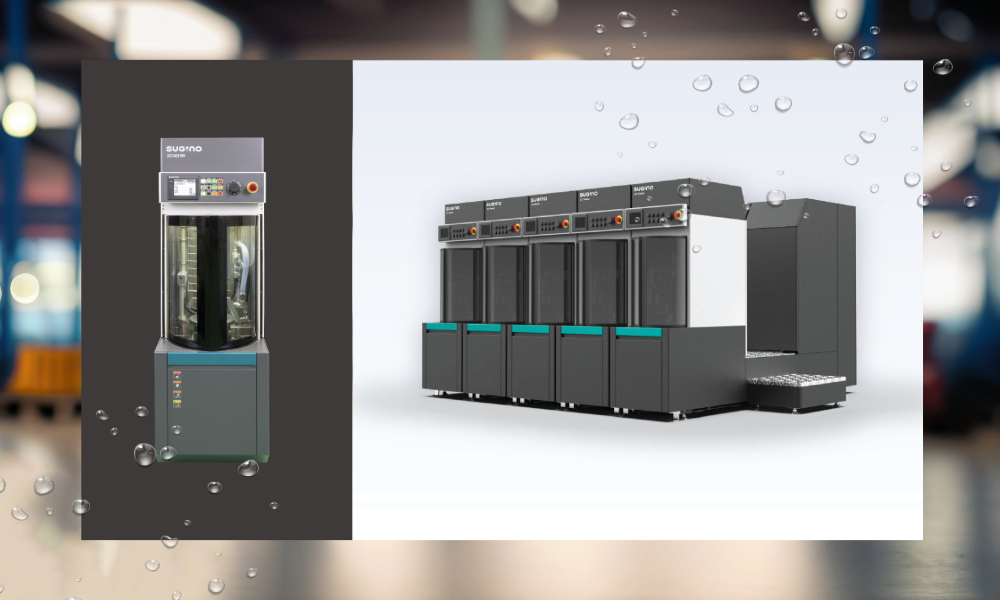
Unlike wash systems designed to sit at the end of a line, the JCC-Module is engineered to integrate directly into the production process, right after machining, and often right at the machine itself. At just 600mm wide, it's compact enough to slot into existing transfer lines and tight shop floor layouts without requiring costly reconfiguration.
That placement matters. Locating the cleaning process immediately after machining helps reduce the likelihood that chips and contaminants will be transferred to downstream operations, fixtures, or equipment.
Swing-Arm Targeted Cleaning: Precision Where It Counts
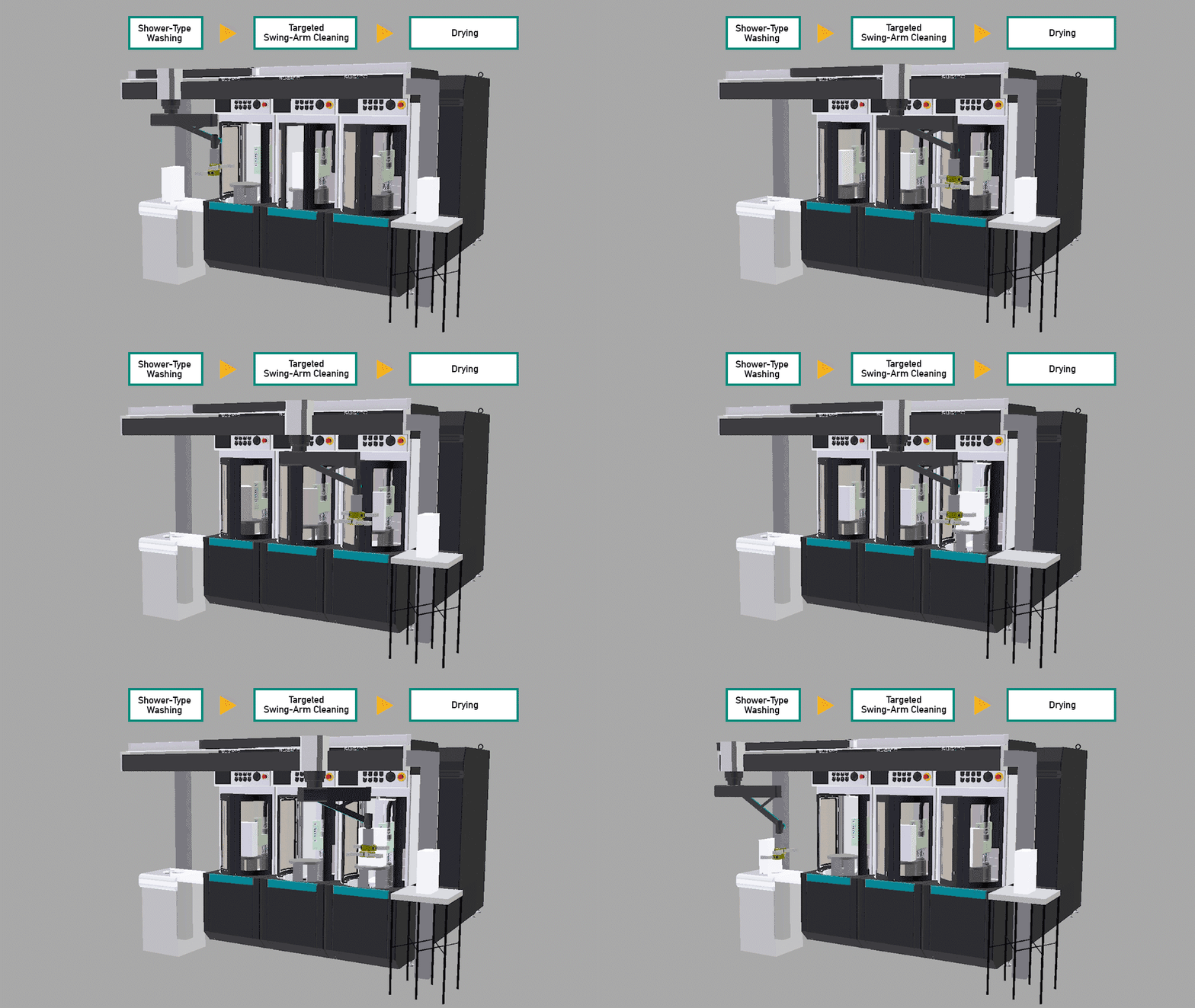
The feature that makes this possible is Sugino's patented Swing-Arm Targeted Cleaning system. It synchronizes the workpiece's rotation axis with the nozzle's three servo axes, continuously tracking and targeting tapped and blind holes while spraying. Threaded holes, blind bores, and recessed internal features are common areas where chips and machining residue can remain after cutting operations.
The JCC-Module combines targeted high-pressure spray (up to 1,000 PSI) with full-surface washing, eliminating the need for manual chip removal and secondary cleaning checks, particularly on parts with complex internal features.
What Are the Benefits of In-Process Cleaning?
Cleaning parts immediately after machining can influence much more than cleanliness. It can affect equipment reliability, inspection efficiency, and process consistency throughout the rest of production:
Cleaner handoffs between operations.
When each station receives a part that's already free of chips and oil, downstream equipment — fixtures, gauges, assembly tooling — stays cleaner longer and requires less maintenance.
Reduced risk of cross-contamination.
Chips or coolant residue carried forward can contaminate other systems, including shared coolant or downstream wash tanks. Removing contamination at the source keeps it from ever entering those shared systems.
Fewer inspection failures and less rework.
Identifying and removing contaminants immediately after machining can reduce the likelihood of additional inspection, troubleshooting, or rework later in the process.
Consistent, repeatable results.
Because cleaning paths are controlled through a CNC platform with servo-driven positioning, each programmed cleaning sequence can be executed consistently from part to part, reducing variability associated with manual processes. This is especially critical for industries like aerospace, medical devices, and fluid power, where cleanliness specifications are non-negotiable.
Shorter cycle times overall.
Eliminating manual chip removal and inspection steps doesn't just improve quality; it removes non-value-added labor from the process entirely, tightening cycle times across the line.

JCC-Module Specifications and Features
Designed to fit where it's needed most.
Successful implementation of in-process cleaning depends on equipment that can be integrated into existing production environments without significant disruption:
- Compact, modular footprint (600mm wide) that integrates into existing lines without major layout changes
- Automation-ready design with integrated NC control, allowing multiple units to be linked via transport systems into a fully automated cleaning sequence
- Ergonomic, color-coded construction that earned the JCC-Module a 2021 Good Design Award, recognized for making the machine intuitive to operate and maintain
- Scalable configuration, so manufacturers can start with a single washing stage and add drying or additional modules as production demands grow
This flexibility is what allows the JCC-Module to be deployed exactly where contamination originates — next to a machining center, integrated into a transfer line, or positioned between operations — rather than being confined to a single end-of-line wash station.
Which Industries Use In-Process Cleaning?
Sugino's Jet Clean Center systems, including the JCC-Module, are already trusted across industries where a missed chip has real consequences:
- Automotive: transmission, engine, and brake components
- Aerospace: machined and cast parts requiring precision cleaning and deburring
- Fluid power/hydraulics: valve bodies and manifolds, where trapped contaminants can cause field failures
- Medical devices: high-tolerance surgical components with strict cleanliness requirements
Although cleanliness requirements vary by industry, the objective is the same: prevent contaminants from affecting subsequent operations. Removing chips and residue immediately after machining reduces opportunities for contamination to influence assembly, testing, or final product performance.
The Value of In-Process Cleaning
In-process cleaning is most effective when it occurs at the point of contamination. Rather than relying solely on end-of-line washing, manufacturers can remove chips and machining residue before they enter downstream operations and equipment.
The JCC-Module was designed specifically for this approach, combining targeted cleaning technology with a compact footprint that can be directly integrated into production environments. The result is a cleaning process that supports contamination control without requiring a separate cleaning stage removed from the machining operation.
Want to see the JCC-Module's in-process cleaning in action? Explore the full specifications or request more information from Sugino Corp.


